Several swords were prominent during Feudal Japan and these are generally known as Japanese swords (日本刀) or nihontō. The kanji used to write Japanese sword(s) include ‘日’ the ideograph for sun, and ‘本’ the kanji for ‘origin’ or ‘root’ (this symbol is a pictorial graphic of a tree with a root at its base indicated by the small cross horizontal line at the bottom of the kanji). These two kanji (日本) are combined to represent Japan (origin of the sun). The third kanji (刀) represents sword: thus all together we have Japanese sword(s). The Japanese do not distinguish between plural and singular nouns.
Most Japanese swords
are not well-defined and categories for length of the weapon are general. The
lengths were measured in shaku (the average
distance between nodes of a mature bamboo stem ~ 1 foot). The primary shaku used to measure most objects in
Japan equals 30.3 cm (11.93 inches).
A general length classification
scheme used for nihontō:
- tantō (knife or dagger) = 1 shaku or
less;
- wakizashi or kodachi (short swords known as shōtō) = 1 to 2 shaku;
- katana or tachi (long swords known as
daitō) = more than 2 shaku;
- ōdachi (long
swords) = more than 3 shaku.
In addition to the above swords, the
naginata and
yari were considered to be part of the
nihontō family even though they were
pole mounted blades.
The most common sword known to Westerners is katana (刀).
The katana is a single edged sword,
with a curve blade whose possession was restricted to the samurai lineage during
Feudal Japan. It was thought that katana were the soul of samurai and was so important that the samurai actually gave names to their
swords, as they were considered to be part of the living.
(1) ōdachi (also known as ōtachi) (大太刀)
The ‘ō’ in ōdachi refers to ‘great’. The kanji for ‘great’ is written as ‘大’
which also means big.
The ōdachi predated katana and had some unique
characteristics. Not only was the sword noticeably long, the ōdachi was marked by religious
inscriptions imprinted on the tang. It is thought by most researchers that
ōdachi were used in ceremonies
prior to battle; and because their length (5 to 6 shaku) was enormous (often longer than
the samurai was tall), it is thought
many were used as cavalry swords. The ōdachi would have been impractical to
carry in an obi (belt) around one’s
waist. Thus, it was thought the weapon was either carried on one’s back, in
hand, attached to a horse, or by an assistant who followed the samurai.
 |
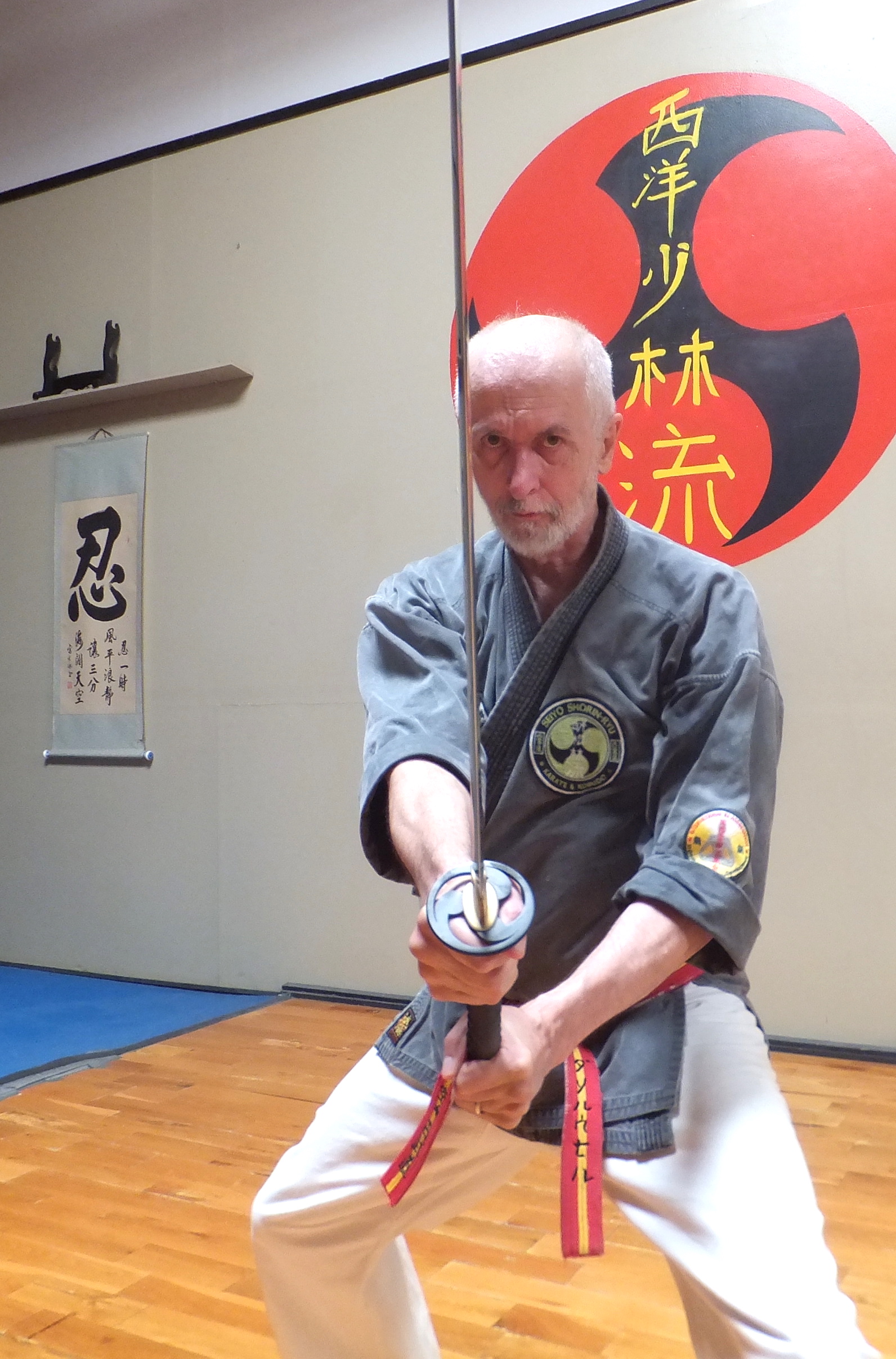
Dr. Teule trains with
bokken at a Seiyo No Shorin-Ryu
Clinic taught by Soke Hausel in Gillette, Wyoming. |
(2) Nodachi
The nodachi is often confused with
ōdachi. However, nodachi refers to any type of long
battlefield or field sword (daitō) as well as a tachi and is often misapplied to any
over sized Japanese sword. It has the same appearance and design as a tachi, but was significantly longer. The
sword is believed to have been used primarily for dueling.
Daitō
(3) Katana (刀).
The katana
(pronounced kah-ta-nah in Japanese
and popularized as ka-tan-a in the
West), was one of the traditional swords worn by samurai. It had a blade larger than 2 shaku with a more moderate curve than
a similar blade known as tachi (see
#4 below). The katana was worn on the
left side of the samurai with the
cutting edge (yaiba or ha) up. The blade included a circular
to square guard (tsuba) separating it
from a long grip handle or pommel (tuska) made for two hands. The blade of
the katana along with the portion of
the blade known as the nakago that
extends into the handle was all one continuous piece known as the tang. Those katana made for combat (shinken) and training (iaitō) have full tang. This simply means that the nakago and ken (blade) are made of one,
uninterrupted, piece of steel. Many cheap practice (iaitō) unfortunately have two
separate pieces - a blade and handle. This results in loosening of the blade
with prolong use until the handle starts to separate from the blade. Thus, when
searching for an iaitō it is best to pay a few extra bucks and
purchase one with a full tang. If you decide to purchase one to train in any of
our dojo, it must be an
iaitō with dull edge. Shinken are way too dangerous for dojo use and in Arizona should be
reserved for trimming cactus.
 |
Sensei Borea demonstrates naginata at
Seiyo Kai Hombu in
Arizona. Sensei is of
true Japanese samurai lineage and is the Staff Samurai at our dojo in Mesa, Arizona. |
The grip handle of
katana is typically covered with ray
skin leather (same’) and wrapped with
cord known as ito. To hold the handle
(tsuka) in place on the nakago, a hole was punched into the
steel nakago and a small bamboo peg
(mekugi) forced through the handle
into the nakago. When the handle is
removed from a well-made katana by forcing the mekugi out, the swordsmith’s signature
should be seen carved into the nakago. The katana was developed from an earlier
sword referred to as uchigatana (打刀). The
katana was carried in a scabbard
known as the saya.
(4) Tachi (太刀). The katana and tachi look very similar but can be
distinguished by locating the mei
(signature) on the sword’s nakago
under the handle. When worn, the mei
would be carved on that side of the tang that would face outward when placed in
one’s obi. Because the tachi is worn with the cutting edge down
opposite of the katana, the mei will be on the opposite side of the tang for this sword. The tachi was often considered as a spare
blade used in battle.
There were tachi with variations from the classical
weapon that included a larger tachi
(see #1 above) known as ōtachi (ōdachi) and a shorter sword known as
kōtachi (kōdachi). The kōdachi was similar in length
to wakizashi (see #5
below).
(5) Wakizashi (脇差)
The wakizashi,
also referred to as wakizashi no
kataka, translates as ‘sword inserted
at one’s side’. The wakizashi
typically had a blade of 1 to 2 shaku. Those closer to the length of a
katana, were referred to as
ō-wakazashi, while a shorter
blade wakizashi was closer to the
length of a tanto and known as ko-wakizashi. The wakizashi was worn with a katana only by samurai. Together, the pair were
referred to as daisho which translates as ‘dai’ (big) and ‘sho’ (little), terms some of us are
already familiar with because some of our advanced karate kata use these terms, such as Passai Dai and Passai Sho.
 |
| Suzette practices Iaido at the Arizona Hombu, Mesa |
The
wakizashi was a back-up sword, also used
for close quarters fighting and for
seppuku (ritual suicide). The size of
wakizashi was not regulated until the
Edo Period when in 1638 AD, only
samurai were allowed to wear
katana of a regulated length. At this
time
wakizashi were also regulated.
Samurai were allowed to wear both
swords while those of the
chonin
class (merchants) were only allowed to wear a shorter
ko-wakizashi to protect themselves from
bandits. It was customary for
samurai
to leave
katana at a door of a
castle, but they always carried
wakizashi. The wakizashi was the
samurai’s honor blade and would never
leave his/hers side, so much so, that it is reported
samurai even slept with them under their
pillows.
The tanto was a knife worn by samurai of feudal Japan. One variety was
that of the yoroi tōshi or dagger (about 8
inches long) that had a greater thickness and used for piercing armor. Another
tanto was the aikuchi (匕首). The
aikuchi had the distinctive
characteristic of no tsuba, similar
to another dagger known as a kaiken. See also ken
tanto below (#8). Even so, many tanto had tsuba, such as the tanto given to me by the Utah Shorin Kai at the last Gassuku (see photo to right of tanto with shaku
measuring tape).
Miscellaneous
The chokutō had a straight blade and was
introduced to Japan from Korea.
(8) Kusanagi no Tsurugi
This was a
double-edged sword used in the 5th century in Japan and similar to
the ken tanto (double-edged
knife).
(9) Shirasaya (白鞘)
Shirasaya translates as
‘white scabbard’. This was a sword that had a plain wooded blade mount
consisting of a saya (scabbard) with
a tsuka (hilt) and traditionally used
for storage when a sword blade was not needed for some time. In this form, it
was not used on a battlefield.
The shikomi-zue is a sword-stick. These
typically contained a blade inside a cane (tsue) mounting for concealment. Some of
these also concealed other weapons such as pepper powder (metsubuski), chains, hooks, etc.
Schools (dojo) and Styles (ryu)
Most
Japanese swords are traced to one of five provinces in Japan that included Shoshu, Yamato, Bizen, Yamashiro and Mino. There were different styles and
systems of Japanese swordsmanship and training.
Kenjutsu,
Kendo
Kenjutsu (sword techniques) is the martial art
combat sword training. Similar to kenjutsu is kendo (way of the sword). Both tend focus on
techniques of the sword after it has been drawn from the saya (scabbard). Kendo-ka practice with bamboo swords known as
shinai, while wearing padded clothing known as bōgu and head gear
known as men. Most kenjutsu use sword.
 |
| Kyoshi Rob Watson explains to members of the Utah Shorin Kai about kenjutsu and kendo while wearing bōgu and men of kendo and showing katana of kenjutsu. To the right, Renshi Todd Stoneking hands shinai to Kyoshi Watson. |
Iaijutsu (iaidō 居合道) and
Battōjutsu (抜刀術)
Iaijutsu, iaidō and battōjutsu are fast draw arts
designed to develop fast draw with follow-up attacks with the sword. These arts
are similar and generally only differ in training methods. For instance, battōjutsu incorporates
multiple cuts following the draw of the sword; while iaidō emphasizes reaction to unknown
scenarios, or a reaction to a sudden and swift attacks. In iaidō, the student begins training
with a bokken (wooden practice sword)
and later switches to a iaitō (dull-edged practice sword).
Only very experienced practitioners use shinken (live blade) because of the
extreme danger to oneself. Because iaidō is practiced with a weapon, whether it is a
dull or live, nearly all training is by kata that includes drawing the
weapon followed by cuts and finishing with ceremonial de-blooding of the blade
and replacing the weapon back into the saya. Sparring is not part of
iaidō, but is instead restricted to kendo.
Another art that is similar to iaidō, is that of jōjutsu (training with a 4-foot staff).
.JPG) |
Sojutsu (art of the spear), just one of
many martial arts taught at the Seiyo
no Shorin-Ryu Karate Kobudo Kai
Hombu dojo in Arizona. |
According to
Wikipedia, some styles of
iaidō include Muso Jikiden Eishin-Ryu, Muso Shinden Ryu, Mugai-Ryu,
Jikyo-Ryu, Suio-Ryu,
Motobu Udundi
(Okinawan), Shindō Munen-ryu, Shinkage-ryū, Hōki-ryū
, Tatsumi-ryū
, Tamiya-ryū
, Tenshin
Shōden Katori Shintō-ryū
, Takenouchi-ryū
,Eishin-ryū
Sword testing, known as
tameshigiri was designed
to test the blade’s sharpness and the practitioner’s abilities to cut a variety
of materials. Today, we often see cuts on straw on a vertical pole. In the past, it was not uncommon for some Japanese
to test on cadavers of executed criminals.
Few iaidō schools practice tameshigiri.
Samurai arts are also part of Seiyo
Shorin-Ryu Karate and Kobudo. In addition to iaido, our
members train in jujutsu, hojojutsu, hanbojutsu,
naginatajutsu and yarijutsu.
Some Books On Nihonto
Craig, Darrell, 1981, Iai – the art
of Drawing the Sword: Lotus Press, Tokyo, Japan, 257 p
Yumoto, J, M., 1958, The Samurai Sword – A Handbook:
Charles E. Tuttle Co, Tokyo, Japan, 191 p
Warner, G. and Draeger, D.F., 1982, Japanese
Swordsmanship – Technique and Practice: Weatherhill, Boston, 296 p
Zier, Don, J., 2000, Japanese Sword
Drawing: Unique Publications, Burbank, CA, 317 p


%202020-08-21%20Seiyo%20Hombu%20dojo,%20Mesa,%20AZjpg.jpg)


.JPG)